Day 14 · Borgesian map — The Aleph of health care
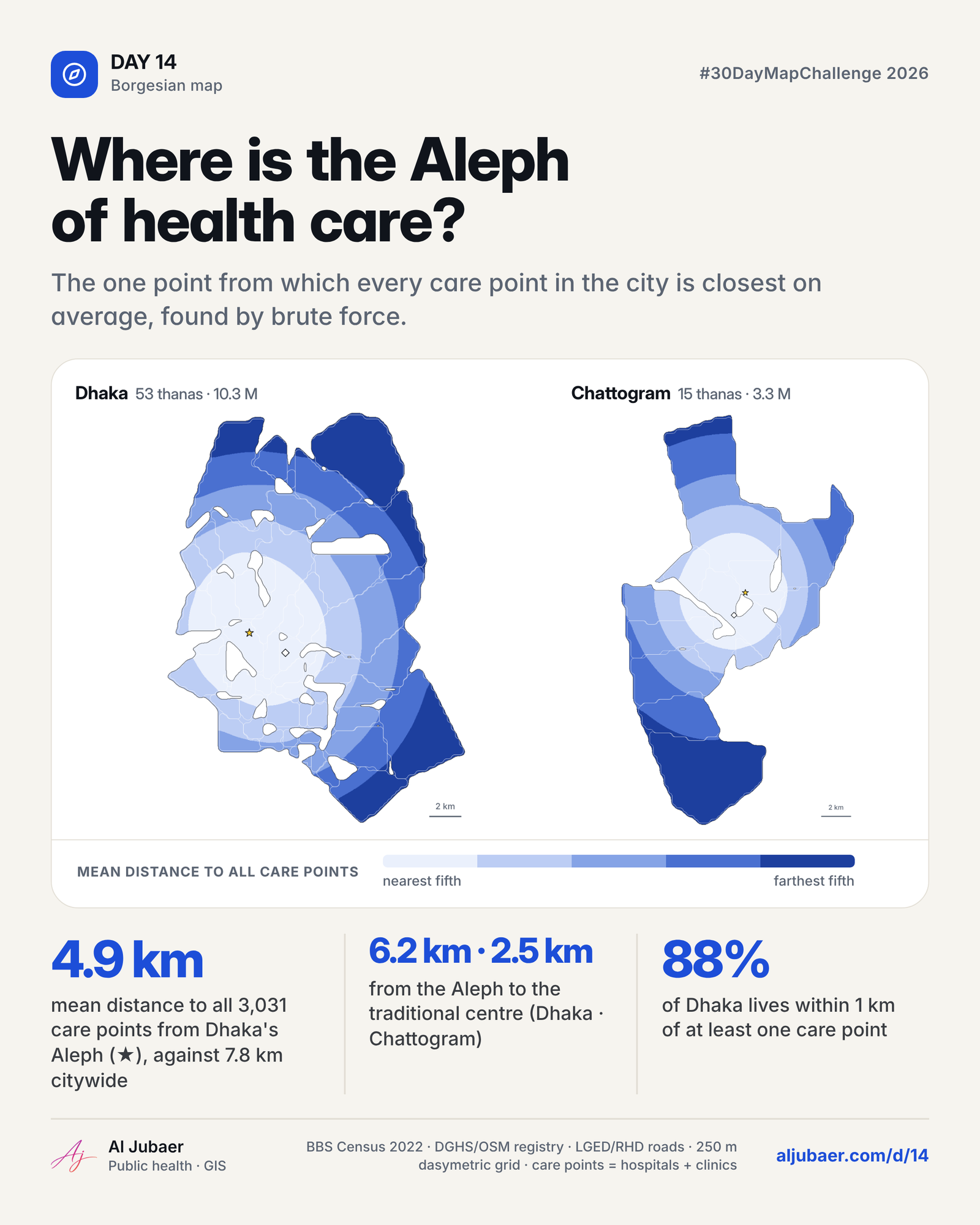
Borges’s Aleph is the point that contains every other point. Here: the place in each city with the smallest average distance to every hospital, clinic and pharmacy. Dhaka: 4.92 km mean distance from the Dhaka Aleph to all 3,031 care points. Chattogram: 5.7 km mean distance from the Chattogram Aleph to all 616 care points.


Write-up
The question
Where is the Aleph of health care in Dhaka and Chattogram — the place with the smallest average distance to every hospital, clinic and pharmacy — and how well off is everyone else?
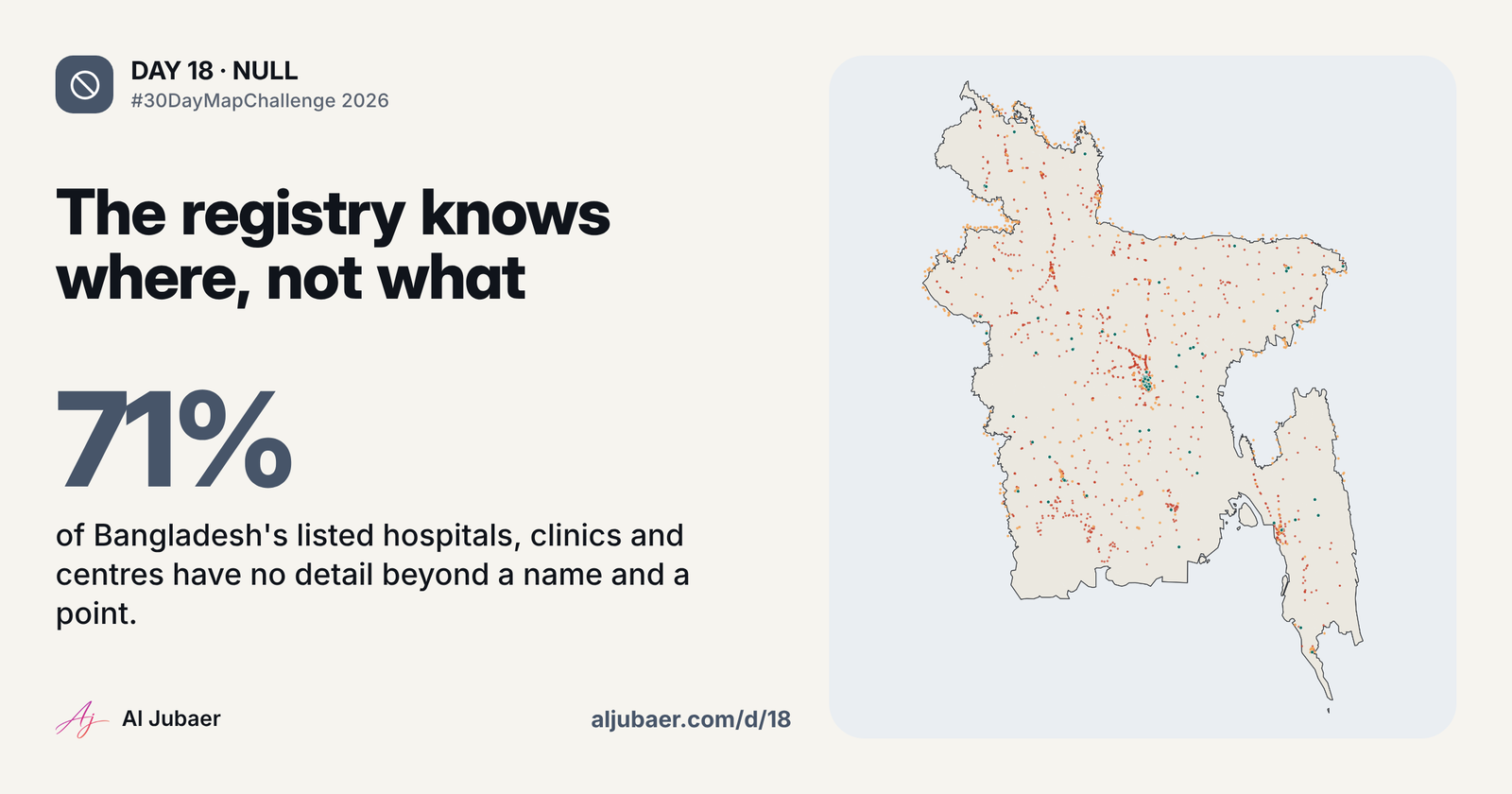
Data
BD Hospital Dataset (hospitals, clinics, pharmacies), fire stations, garment factories, economic zones and major roads from the GIS Data folder; BBS Population and Housing Census 2022 thana populations; city-corporation boundaries. The registry is incomplete and urban-biased; population per 250 m cell is a dasymetric model; distances are straight lines in UTM 46N.
Methods
- Study areas: the two Dhaka city corporations (DNCC + DSCC, 53 thana polygons, 10,250,630 people) and Chattogram City Corporation (15 thanas, 3,273,329 people), BBS Population and Housing Census 2022. White gaps on the maps are outside the corporations (cantonment, airport, water).
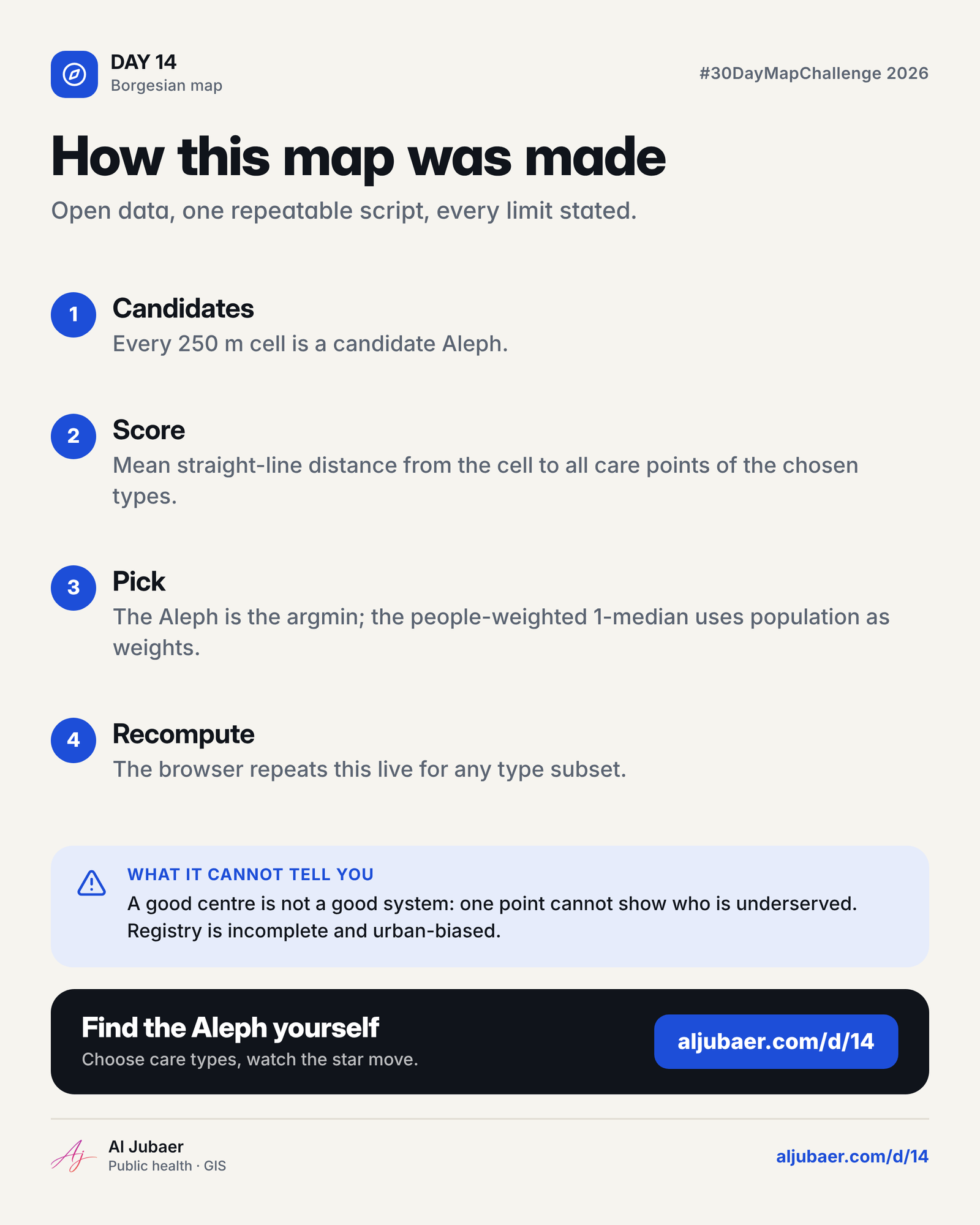
- Health facilities: the BD Hospital Dataset in the GIS Data folder, split into hospitals, clinics and pharmacies from the type and name keywords; pharmacies within 25 m of each other merged; an ‘emergency / 24 h’ flag from the name and type. Dhaka: 475 hospitals, 507 clinics, 2,049 pharmacies, 44 fire stations. Chattogram: 160, 51, 405 and 24.
- Where people live: the census gives thana totals only, so each thana total is spread over a 250 m grid in proportion to a Gaussian kernel (σ = 400 m) of settlement proxies — mobile-phone towers, mosques, schools, health points, pharmacies, hospitals — plus a small floor. Cell sums equal the census total exactly (checked).
- Care points = hospitals + clinics + pharmacies (Dhaka 3,031; Chattogram 616). For every 250 m cell the mean straight-line distance to all points is computed (cells × points, about 13 million distances); the Aleph is the argmin.
- People-weighted 1-median: among the 500–600 most central cells, the cell that minimises the population-weighted sum of distances (the Weber point).
- Also per cell: the number of care points within 1 km and 2 km, plus the percentile of that count in the population.
- The web page recomputes everything in the browser for any subset of types (hospitals / clinics / pharmacies) using typed arrays.
Findings
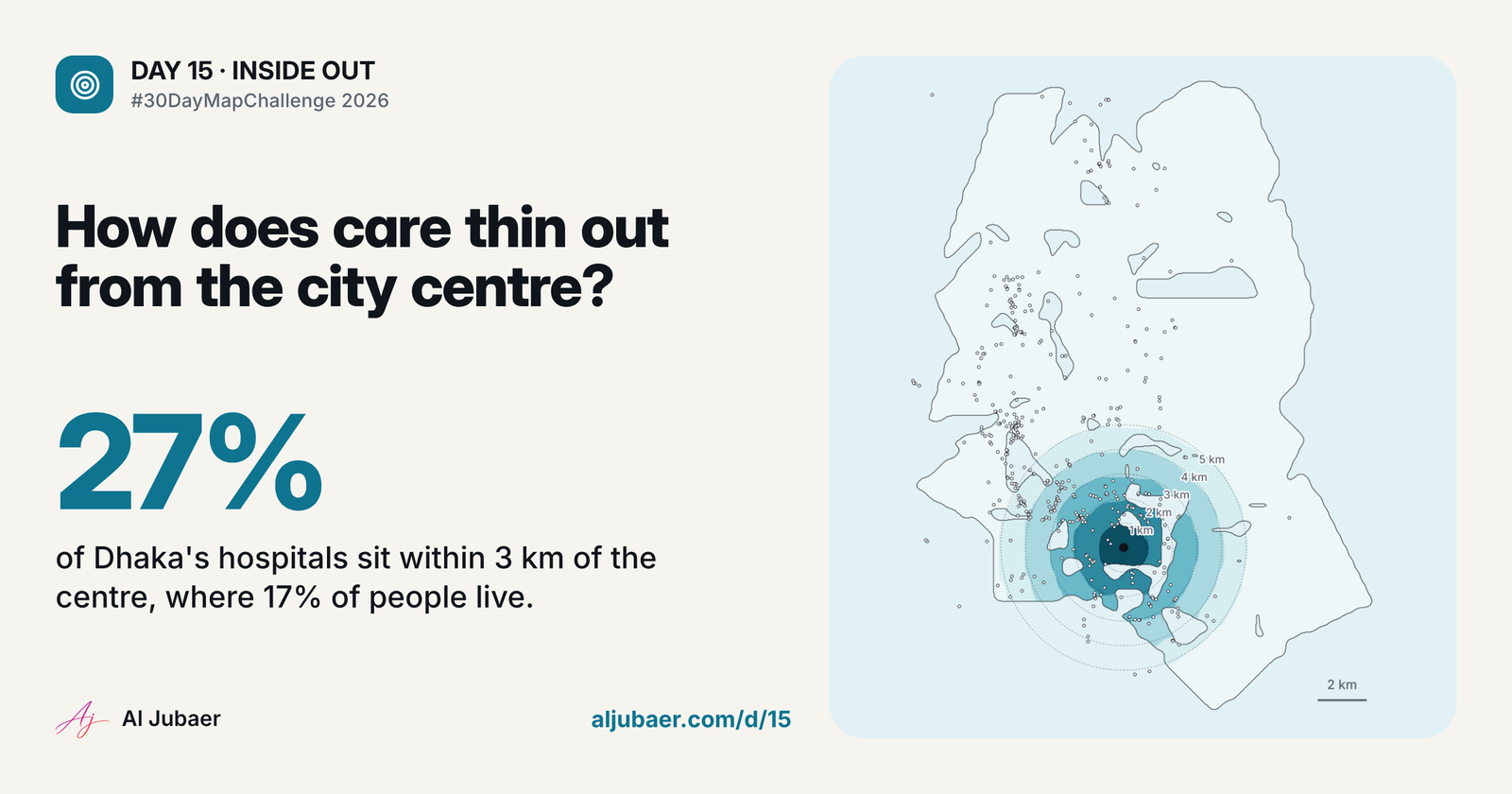
Dhaka — The Aleph of Dhaka (23.7758° N, 90.3788° E) is the 250 m cell whose mean distance to all 3,031 care points is smallest: 4.92 km, against a city average of 7.81 km.
Dhaka — It is 6.2 km from the traditional centre — the centre of the facilities has moved away from the centre of the old city. The people-weighted 1-median (least total walking for all residents) is a different cell, 6.06 km on average.
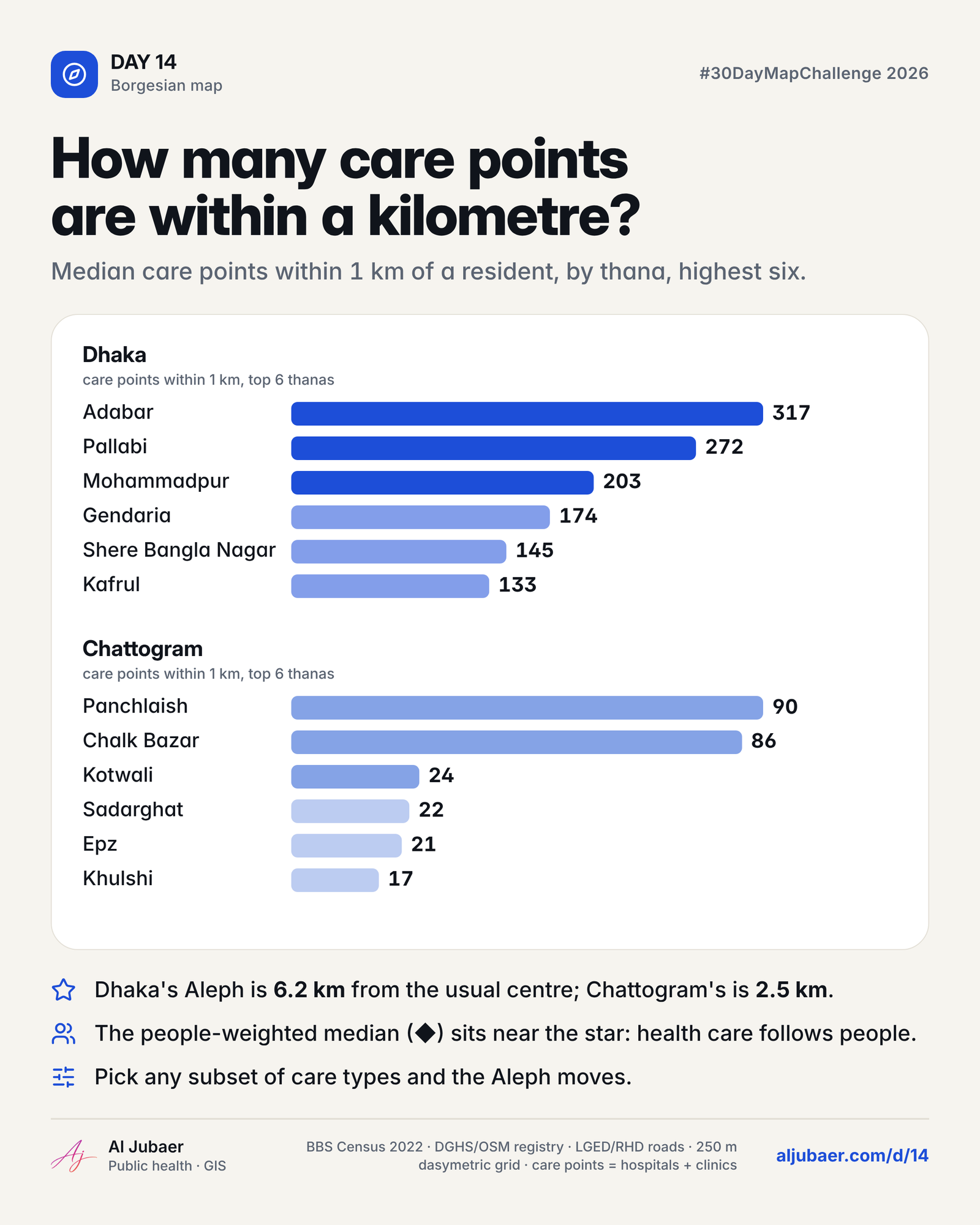
Dhaka — A typical resident has 35 care points within 1 km; the lowest tenth has 0, the highest tenth 206+. 73.2% of people have at least 10 within 1 km and 41.4% at least 50.
Dhaka — Fewest care points within 1 km (average resident): Uttarkhan 0, Khilkhet 1, Demra 1. Most: Adabar 317, Pallabi 272, Mohammadpur 203.
Chattogram — The Aleph of Chattogram (22.3598° N, 91.8236° E) is the 250 m cell whose mean distance to all 616 care points is smallest: 5.7 km, against a city average of 7.81 km.
Chattogram — It is 2.5 km from the traditional centre — the centre of the facilities has moved away from the centre of the old city. The people-weighted 1-median (least total walking for all residents) is a different cell, 4.74 km on average.
Chattogram — A typical resident has 11 care points within 1 km; the lowest tenth has 0, the highest tenth 36+. 53.9% of people have at least 10 within 1 km and 8.3% at least 50.
Comments & reviews
What you write appears here once it has been approved.
 Web map & dashboard
 Web map & dashboard
 Web map & dashboard
 Web map & dashboard